


Family Home Buyers Caught Up in the Downsizing Delay



For decades, the “empty nest” marked a clear turning point in the property cycle, when parents would release their large family home to the market and move into something smaller.
Today, that moment is arriving much later, reducing the supply of four and five-bedroom houses. A complex set of social and economic factors are delaying that transition, but upsizer demand for these properties has never been greater, RT Edgar director Anthony Grimwade says.
“The traditional downsizing pattern has shifted quite significantly,” Grimwade explains. “Families simply aren’t reaching that ‘empty nest’ moment at the same point they used to. Adult children are staying at home longer, often well into their twenties, and that’s changing when parents choose to sell.
“We’re seeing many upsizers needing more space as their families grow and children move into senior school, but the volume of larger homes coming to market is well below what we saw even a few years ago. Competition, however, has not softened.”
Last year’s Downsizing Australia Report, by REA Group and GemLife, found 85 per cent of homeowners aged 55-plus have two or more spare bedrooms, but aren't selling.
The shift reflects policy settings and financial pressures.
Seniors advocates argue pension and tax rules are discouraging downsizing. At the same time, half of adults under 30 are still living under their parents’ roof, up from 25 per cent in 2006, due to the cost-of-living and the challenge of saving a first-home deposit, research from Household, Income and Labour Dynamics in Australia reveals.
“There’s an emotional layer to it,” Grimwade says. “Parents are very aware of how difficult it is for their children to enter the property market, and that can influence their decision to hold onto the family home for longer, whether that’s to provide stability or to give their children more time.”
Meanwhile, a growing pool of families are reaching the stage where they need to buy a more substantial house.
“The modern family home has to work much harder than it used to,” Grimwade explains. “It’s not just about bedrooms anymore - it’s about how people live within the space. You’ve often got overlapping lifestyles, so those secondary living zones, such as breakout spaces and informal areas, become just as important as the accommodation.”
Melbourne’s market remains steady as it moves through a cycle. PropTrack’s March Home Price Index shows 0.2 per cent median dwelling price growth, month on month. Cotality figures for April reveal values are only 1.3 per cent below the 2022 peak of the market.
Vendor discounting in Melbourne throughout March matched the national record low of -2.9 per cent, according to Cotality shows, and median days on market have also dropped to 35 days from 39 days over the past 12 months.
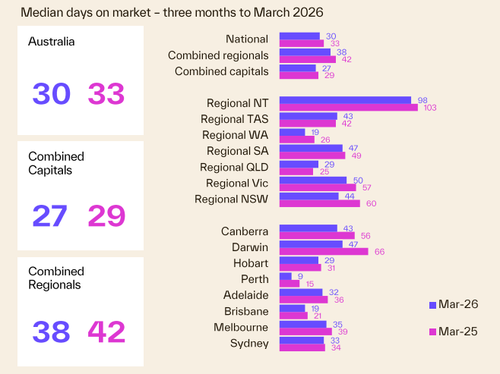
Source: Cotality
Yet, many downsizers are delaying due market perceptions, Grimwade says. “There’s a real hesitation at the moment,” Grimwade explains. “They feel they’re not going to achieve the same result they might have when the market was at its peak. That is enough to keep people holding rather than moving, but we’re continuing to see outstanding results for well-presented homes in the right locations.
“The fundamentals of demand, lifestyle and limited supply are very much in vendors’ favour.”
For downsizers, this underscores the importance of preparation and advice from a knowledgeable agent. “It’s become a more coordinated process,” Grimwade says. “You’re not just selling a home, you’re also working through where to live next.
“Once that is in place, the downsizing decision becomes much easier.”