


High-end Property is Weathering Economic Ups and Downs


Melbourne's prestige real estate market is proving its resilience and delivering rewards, even as share markets sway and new tax rules bite.
Through fluctuating economic cycles and share market turbulence this year, elite property remains a reliable store of wealth, experts say.
Major changes coming to superannuation tax for high-income earners are expected to give luxury real estate further appeal as a wealth-building strategy.
Prestige typically refers to $5 million-plus sales, which represent the top 5 per cent of the market, according to Westpac’s Prestige Property Report 2025. Ultra luxury is defined by the bank as sales of more than $20 million.
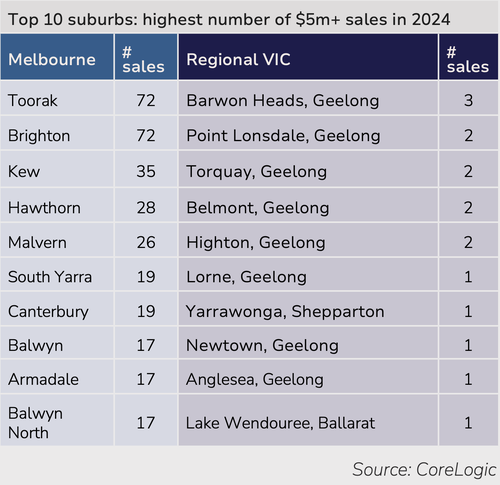
The volume of these blue-ribbon homes changing hands has surged 217 per cent over the last five years, Westpac figures show, and Melbourne remains a traditional stronghold.
Nick Walker, RT Edgar Boroondara director, says scarcity is the fundamental driving force in the prestige market and, by extension, protects capital growth.
“Limited supply of comparable stock - fewer properties that meet the size, aspect, period provenance or location required by high-net-worth buyers - increases competition and premium pricing,” he says. “Location is arguably the single most important factor, but combined with scarcity and quality, it produces an exceptional outcome.”
The criteria for prestige are not monetary alone. Attributes that cannot be easily replicated are key, from views and riverfront positioning to quality finishes, privacy, security, and durable and timeless design that attracts repeat buyers, Walker explains.
Westpac’s analysts found properties with these features attract buyers who are unleveraged. “They function as both lifestyle assets and long-term wealth preservation tools, and are often purchased with little or no reliance on credit,” the report said.
In Boroondara and Stonnington, heritage overlays, development rules and zoning restrictions constrain density, putting a cap on supply. These aspects contribute to a robust outlook. “I believe we will see prestige properties out-performing the median as buyers compete for limited inventory,” Walker says.
“These suburbs combine large, well-proportioned titles, established period homes and high-end contemporary reconstructions, elite private and leading public schools, easy access to CBD, and endearing local landmarks and amenities, which keeps demand and price resilience high,” he says. “They regularly sit at the top of the LGA medians and dominate prestige residential property volumes in Melbourne.”
Share market turbulence, sparked by US policymaking, is positioning prestige property as an “alternative asset class” for investors with a long-term view, Westpac’s chief economist Luci Ellis said in the report.
High-net-worth individuals with large superannuation balances may also find property is a shrewd investment class. Next year’s changes to the tax rate on super balances of more than $3 million and $10 million could drive interest in luxury real estate, Westpac found, because the family home is exempt from capital gains tax.
Prestige buyers’ agent and economist Rich Harvey, chief executive of propertybuyer.com.au, expects the new tax regime to create fresh demand for property. “A lot of tax advisors will definitely be talking to their clients about that,” Harvey says. “Upgrading their home, and pouring some more money into that, certainly preserves capital.”
Harvey says the percentage of owner-occupiers in Melbourne’s elite suburbs over the past 20 years has risen. Increasingly, property in these suburbs are seen as long-term, generational assets, with strategic financial advantages.
“Melbourne has classic architecture and a demographic that really drives value,” he says. “Property is a flight to quality, and a great way to store intergenerational wealth. There are very few tax shelters where you can invest millions and millions of dollars and keep it within the family.”